Valentine, Ne

Smith Falls, just northeast of Valentine. The state's tallest waterfall.

Two of our very own took the holiday weekend to venture up to one of Nebraska's hidden gems, Valentine, Nebraska. It just so happens the world famous Heart City Bull Bash was in full swing. Talk about rural small town charm. Felt like we were home again. Lots of friendly folks, lots of hiking, and lots of whiskey. Definitely something to add to our annual traditions list. Check out the video below for an idea of what we were up to (sans Bull Bash).


explore »

Omaha Beer Week

"After witnessing firsthand the revival of Narragansett in New England and now Schlitzin the upper Midwest, I’m ready for this retro beer craze to get local. I’m a hi/lo beer drinker. Enjoy the good stuff but there’s a time and place for some swill as well and if I’m going to drink a $2 beer I’d just as soon sip a piece of Omaha history than a PBR tallboy." - Rogue's Rookery

In the spirit of the kick off tonight of Omaha's 2012 Beer Week, and our recent discovery of fantastic Omaha blogger over at Rogue's Rookery, we are pleased to feature a special post of his own creation exploring the history of Omaha breweries. All credit goes to Brandon Vogel. Don't forget to keep up with the festivities beginning tonight going through the 10th. You may even see us about town in one of our usual spots; Krug Park, Crescent Moon, Brothers, Upstream, Jake's Cigars... Enjoy.

For nearly a hundred years, between approximately 1860-1960, there were three breweries (and one distillery) cranking out beer in Omaha: Metz (1856-1961), Krug (1859-1972), and Storz (1876-1972). Like most local macros, the clock started to tick as brewing giants–Anheuser-Busch, Coors, Miller, etc.–continued to find better ways of shipping their product. There was once a time where a traveling salesmen had no choice but to drink what was made nearby. Over the past twenty years or so microbreweries have risen up to brand themselves as the beer of a region or city. If you’re in Kansas City you drink a Boulevard. San Francisco? Anchor Steam. Texas? Shiner. Colorado or Vermont? The choices there seem to grow daily.
I’m all for choice, but it would be nice to have the chance to have a Storz again (or in my case, for the first time). Doesn’t really matter if it was good or not. That, of course, is not what “retro beer” is about.
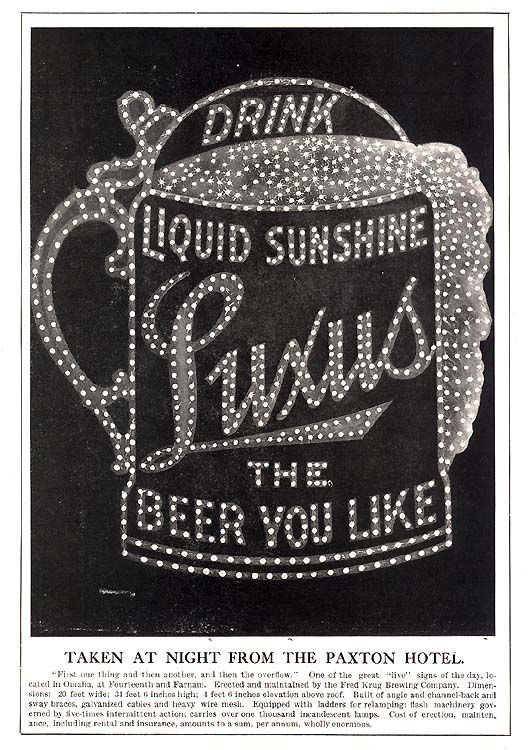
KRUG: Founded by Frederick Krug, this was Omaha’s downtown brewery and, from a visual standpoint, my favorite of the old Omaha brews. In addition to Krug, they also brewed Cabinet and Luxus brand beers, the latter of which resulted in this beauty of a sign that sat atop the Paxton Hotel:
"First one thing and then another, and then the overflow." One of the great "live" signs of the day, located in Omaha, at Fourteenth and Farnam. Erected and maintained by the Fred Krug Brewing Company. Dimensions: 20 feet wide; 34 feet 6 inches high; 4 feet 6 inches elevation above roof. Built of angle and channel-back and sway braces, galvanized cables and heavy wire mesh. Equipped with ladders for re-lamping; flash machinery governed by five-times intermittent action; carries over one thousand incandescent lamps. Cost of erection, maintenance, including rental and insurance, amounts to a sum, per annum, wholly enormous.
Of the original Krug brewery that covered more than a city block with it’s stables, ice house and ballroom, only the Anheuser-Busch Beer Depot remains. One of my favorite buildings in Omaha.
Anheuser-Busch Beer Depot 10/09
Cabinet Ad
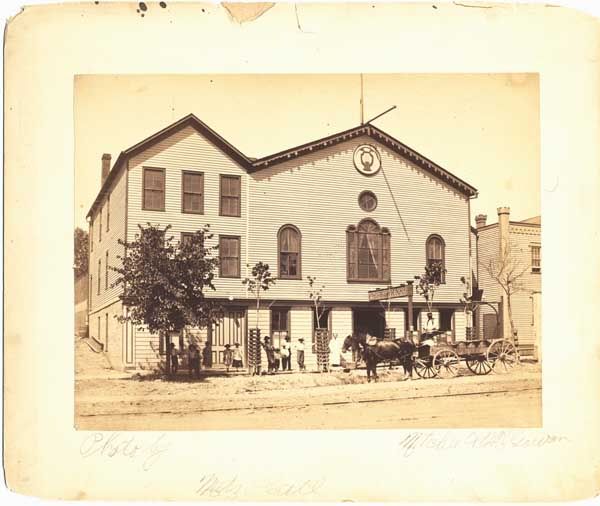
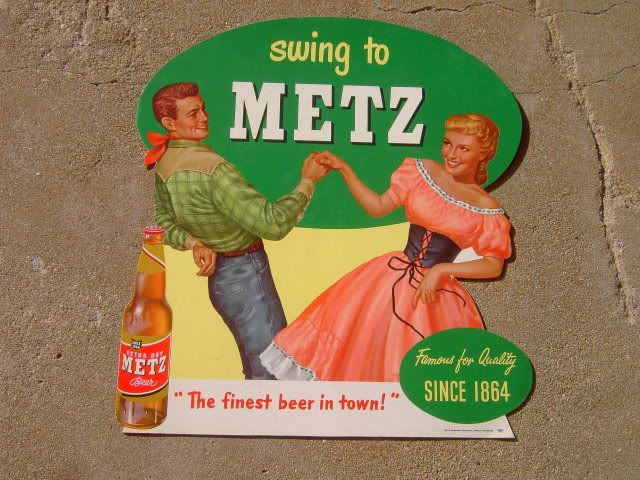
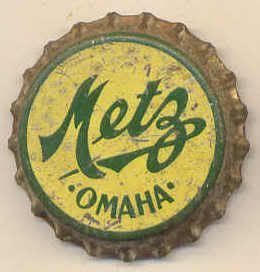
METZ: The first brewery in Nebraska, founded as McCumbe Brewery, was purchased by Frederick and Joseph Metz in 1861. Like most breweries of the day, the Metz brothers built a beer hall on 10th street to serve their product. By 1920, done in by prohibition, the brewery at 6th and Leavenworth had been sold to Corn Derivatives Company. Metz continued to be brewed through 1961 by Walter Brewing Co. of Colorado. You can still find a Metz ad on the “Omaha building” at 11th and Dodge.
Metz Bros. Beer Hall, 1879
Metz ad on the "Omaha building"
Metz C&W Ad
Metz cap
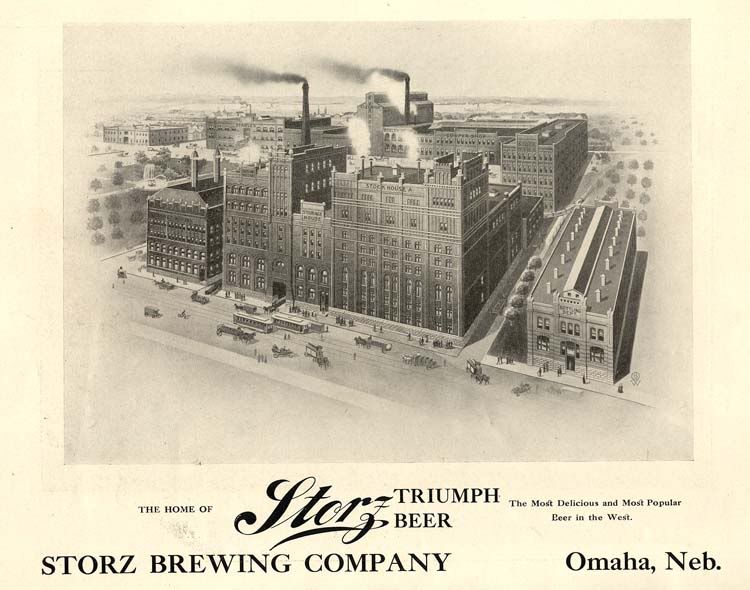
STORZ: Family owned for 67 years, Storz was perhaps the biggest success story of the Omaha breweries. After surviving prohibition, Storz continued to be brewed in Omaha up until 1972 when Grain Belt Breweries of Minnesota closed the brewery located at 1807 N 16th Street. The brewery’s chimney still exists today as does the mansion Gottlieb Storz built in Midtown.
Storz Brewery Chimney, 10/09
Storz Brewery Ad
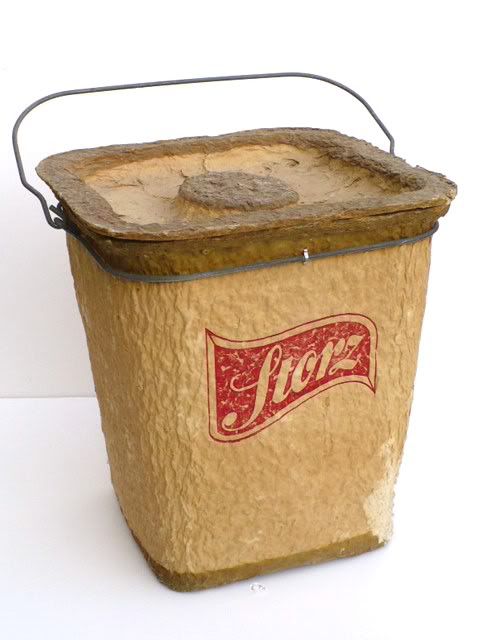
Owing to the relatively recent demise of Storz, there’s a lot of memorabilia out there, including this from the days where a bucket of beer literally meant a bucket full of beer.
Storz beer bucket
So what would it take to revive one of these? The rights and an original recipe, of course, but more than anything else passion, a desire to keep a piece of history alive. Finally, Lucky Bucket looks poised to become the “Nebraska beer” that I’ve always longed for and they’ve displayed just such devotion to the craft and historical knack with their pre-Prohibition lager. As they continue to grow, maybe there will be a time where they’re ready to look back rather than forward for their next beer.
If that comes to pass, they could do worse than to look at what Narragansett has done with their branding. A great color scheme and some retro loving designers and writers can go a long way. Check out this campaign to bring their brewery–currently located in Rochester, NY–back to New England.
Further Reading: If you’re interested in the full story of beer in America, check out Ambitious Brew by Maureen Ogle. Good read.
explore »

Bio: M.F. Mullins

M.F. Mullins. Champion Beef Dresser of the World. Known to fully butcher an 1,800 pound steer in roughly 7 minutes.


Mr. M.F. Mullins was born in New York, 1863. As a young man of 18 years, he joined the butchering operation of Swift & Co. in Indiana. When he was hired the company ran at a leisurely 60 head of cattle a day. By the time Mullins found his calling, he saw the quota rise to nearly 7,000 a day. Much of the success witnessed by the Swift shareholders can be attributed to Mullins' mind blowing speed with a knife. He was considered the undisputed fastest butcher in the world and demonstrated his marvelous skill in front of awestruck crowds countless times in his career.


The first contest he entered was the Butchers Exhibition in Chicago of 1883. He competed against eight of the world's top dressers and was awarded first prize. He would go on to win first prize again in 1887, 1889, and twice in 1890 (in front of 15,000 people, no less). It was obvious that no man in the world could best him. Above is an ad showing the types of knives that would have been used in his time.


He would go on to display his talents in educational demonstrations for agriculture classes throughout the country. One such class was held in Des Moines, Iowa (1902) in front of hundreds of students using cattle purchased from the Omaha Union Stockyards, considered to be the highest quality beef in the world one could purchase at the turn of the century.


Could he have been the inspiration for cinematic badass, Bill "The Butcher" Cutting? Yep.

explore »

Custom Boxes Now Available!


We are quite pleased to announce that Fontenelle Axe Restoration now offers custom built pine boxes to protect and display your beautifully restored piece of American logging history. They are built specifically to your axe's dimensions and will soon be available for purchase in addition to your axe on etsy.com.


explore »

Bio: Hugh Glass

An actual photo from 1823 of mild mannered frontiersman, Hugh Glass, dancing with his pet grizzly, Daisy.

Hugh Glass was a nobody from Pennsylvania who had a knack for trapping small furry animals and being tougher than everyone else. He is said to have been a sailor, pirate, Pawnee Indian, explorer, prisoner of war, bear wrestler, wilderness survival expert, master canoeist, fur trader, co-Yellowstone discoverer, and fellow ad responder to General William Ashley's campaign of one hundred men to "ascend the river Missouri".

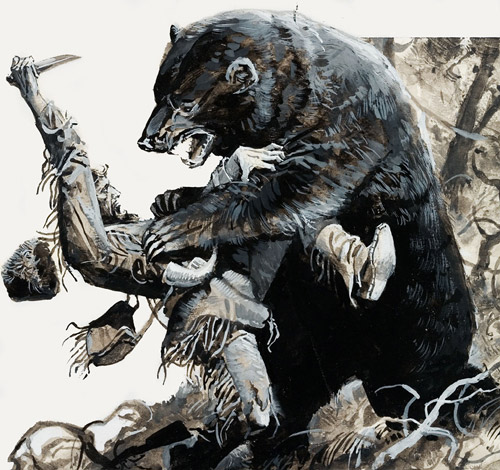
Now the badassity begins. Hugh Glass was scouting an area alone near present day Perkins County, South Dakota when he surprised a mother grizzly and her cub. She charged and began to maul him till he was nearly dead. But Glass would have none of it. Despite his critical loss of blood (from gashes so deep his ribs were exposed) and broken leg, he managed to reach his trapper's knife and proceeded to deal her a series of punches and stabs, eventually killing the bear and leaving him pinned under the 400 pound animal. The company of men he was traveling with later found him in this condition, the leader of which ordered two men to stay behind, roll the bear off him, wait till he died, then bury the body. As they were digging his grave, the two men were attacked by Arikaree Indians, stole the crippled man's knife and rifle, and took flight. By this time Glass had lost consciousness, thus ultimately saving his life as the ambushing indians presumed him to be dead.

He eventually regained consciousness, RESET HIS BROKEN LEG, wrapped himself in a bear hide (I so want to say it was the hide of the bear he killed with his own hands, but this is unconfirmed), and began crawling. Two. Hundred. Miles. Along the way, he had to perform such unheard of survival feats including, laying on a rotten log so the maggots would eat away the bacteria that would lead to gangrene, fight off two wolves from a recently killed bison calf and eat the flesh, and SEWED a bear hide onto his back to cover his still healing wounds. Yeah. 

Hugh glass would eventually recover from his incredible journey and track down the two men who left him to die, Bridger and Fitzgerald, planning on killing them. In the end, he spared both men for different reasons, Bridger because he was so young, and Fitzgerald because he was enlisted in the U.S. Army. Even after he had every reason to take his full revenge he showed the marks of an extraordinarily honorable man. Although, as you can see below, his appearance would suggest otherwise.


explore »

To Shave A Sleeping Mouse

The Coolamine Homestead. First settled in 1883, now sits in the confines of the Kosciuszko National Park in NSW, Australia.

Here is an inspiring example of folks who are passionate about preserving the life's work of their ancestors. Bill Boyd and Mark Garner were part of an ongoing effort in 1984 to restore the Coolamine Homestead, as well as other important sites, using traditional tools and methods handed down from the original builders of these traditional log buildings.


Listen, within the first minute or so, for a bit of an old timer Aussie's advice on the axe sharpening standard of a true bushman.

"...sharp enough to shave a mouse asleep."
explore »

Followers

Copyright © 2012, All rights reserved. Powered by Blogger.